Green concrete in Westfield, IN isn't a marketing label, it's a specific set of material and process choices that cut waste, lower carbon output, and extend the life of a slab. This guide breaks down what actually counts as green concrete, which options exist for Hamilton County homeowners, and the surface prep step most guides skip entirely. By the end, you'll know what to ask for before you sign a contract.
What "Green Concrete" Actually Means
Most articles online use "green concrete" loosely. The real, technical definition is narrower.
Industry researchers define green concrete as a mix that minimizes cement content, incorporates supplementary cementitious materials (SCMs) such as fly ash and slag, and is optimized to meet performance goals with lower cost and carbon intensity.
In practice, that means swapping out a portion of standard Portland cement for:
- Fly ash, a coal-combustion byproduct that replaces cement and improves workability
- Slag cement (GGBFS), a steel-industry byproduct that adds strength and durability
- Silica fume or natural pozzolans, which densify the concrete and reduce permeability
- Recycled aggregate, which replaces some virgin sand and gravel
Supplementary cementitious materials are already used as a partial cement replacement in roughly 60% of modern U.S. concrete mixtures, according to Iowa State University's National Concrete Pavement Technology Center. So "green concrete" isn't exotic, it's an upgrade to a mix design that most ready-mix plants can already supply.
The ready-mix industry itself has been tracking this shift for over a decade. National Ready Mixed Concrete Association members reported lowering their average carbon footprint by 21% between 2014 and 2021, largely through SCM use and production efficiency.
Eco-Friendly Concrete Options for Westfield Homeowners
When you're pouring new concrete in Westfield, you have more say in the mix than most homeowners realize. Ask your contractor or supplier about:
- Fly ash or slag-blend mixes for driveways, patios, and slabs, requested directly from the batch plant
- Permeable (pervious) concrete for walkways or parking pads, which reduces stormwater runoff
- Recycled aggregate base under new slabs, which cuts down on hauling virgin gravel
- Shorter transport distances, since cement production and trucking both add to the carbon footprint of a pour
None of these options require sacrificing strength. The EPA has evaluated fly ash as a cement substitute and continues to support its beneficial use in concrete after finding no elevated environmental risk compared to conventional mixes.
Freeze-Thaw: Why Climate Shapes Every Green Concrete Decision Here
Westfield sits in a climate zone that puts real stress on concrete every winter. Repeated freezing and thawing forces moisture in and out of the slab's pore structure, and that cycle is a leading cause of surface scaling, cracking, and eventual spalling.
Green concrete mixes don't get a pass on this. If anything, proper air entrainment matters more in an SCM-based mix, because fly ash and slag change how the concrete cures and how quickly it gains early strength. A mix that's "eco-friendly" but poorly air-entrained will fail the same way standard concrete fails in a hard Indiana winter.
If you're already seeing flaking, pitting, or crumbling edges on an existing slab, that's a different problem than mix design. We cover the causes and fix options in our guide to spalling concrete in Westfield, IN.
The Part Most "Green Concrete" Guides Skip: Sustainable Surface Prep
Here's what almost nobody writing about green concrete mentions: the mix is only half the story. What happens to the surface before a sealer, coating, or overlay goes down matters just as much for long-term sustainability, and it's where our crew spends most of our time.
Traditional dry sandblasting throws a lot of spent abrasive and dust into the air and the ground. OSHA's respirable crystalline silica standard for construction exists specifically because dry blasting on silica-containing substrates like concrete creates a measurable worker health hazard.
We run a different process:
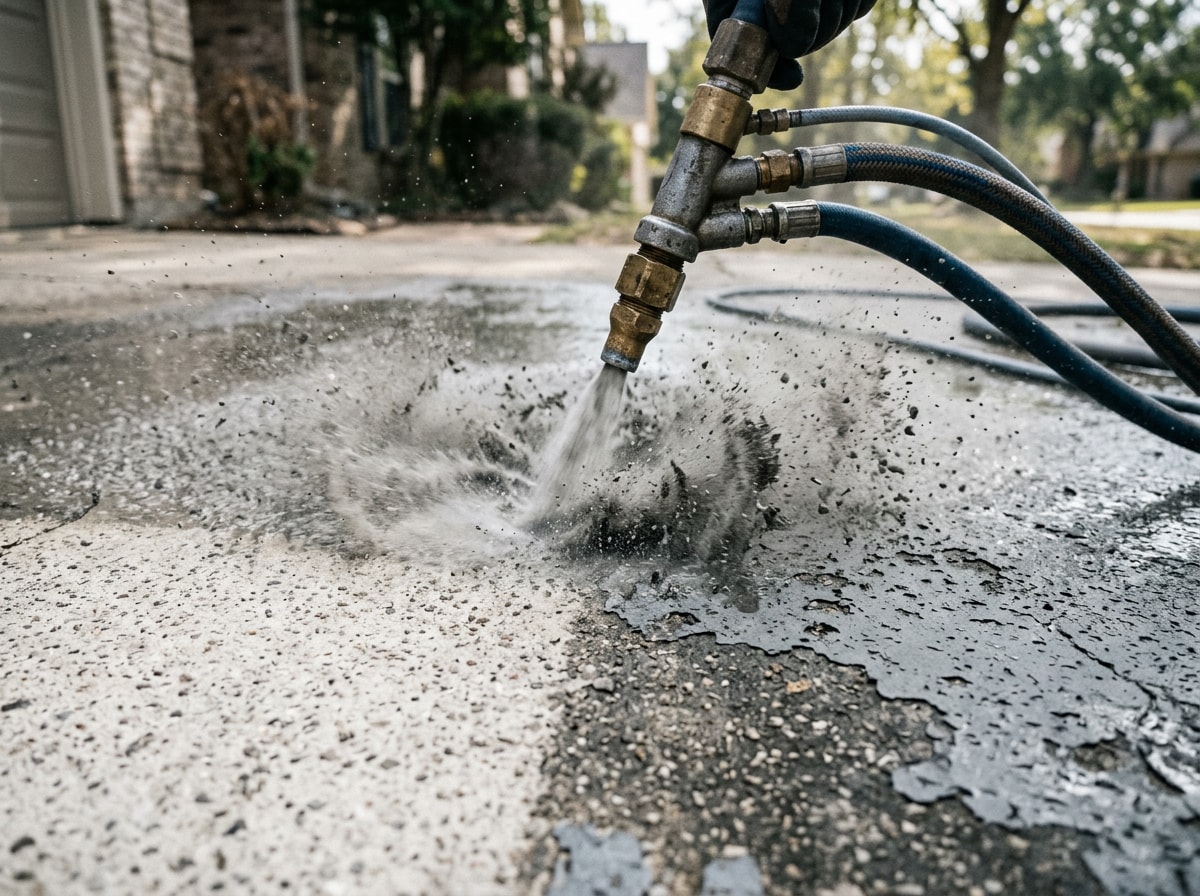
- Wet or dustless blasting that suppresses the dust plume at the source, keeping debris contained instead of airborne
- Recycled abrasive media, including crushed glass and reclaimable garnet, which cuts down on virgin material use and landfill waste
- Targeted profiling instead of over-blasting, so we remove only what's failing and leave sound concrete alone
This isn't theory for us. On a recent driveway resurfacing job near Westfield, switching from dry blasting to a dustless method cut cleanup time nearly in half and eliminated the dust complaints we'd normally expect from close neighbors. That's the kind of detail you only learn by doing the work, not by reading a materials spec sheet.
If you're planning to resurface, recoat, or repair existing concrete, proper prep extends the life of whatever goes on top of it, which means fewer redo jobs and less material waste over time. See our concrete surface preparation and concrete sandblasting services for the specifics, or ask about mobile sandblasting if you need the crew to come to you.
Eco-Friendly Sealers and Coating Prep
Once a surface is properly prepped, the sealer or coating choice is the next sustainability lever. Low-VOC and water-based sealers reduce harsh chemical runoff and off-gassing compared to older solvent-based products, and they hold up well on both new green concrete and resurfaced older slabs.
Good prep work also means you need less aggressive stripping chemistry the next time the coating wears out. That's a real, compounding savings over the life of a driveway or patio. Our pre-painting surface prep and coating preparation services are built around that exact goal: get the surface right once so the finish lasts.
What Green Concrete Costs in Westfield, IN
Fly ash and slag blends are often cost-neutral or slightly cheaper than straight Portland cement mixes, since SCMs are industrial byproducts rather than freshly manufactured material. Permeable concrete and specialty finishes carry a premium. Here's a general planning range:
| Option | Typical Cost Range (installed) | Notes |
|---|---|---|
| Standard concrete slab/driveway | $6-$10 per sq ft | Baseline for comparison |
| Fly ash/slag-blend mix | $6-$11 per sq ft | Often comparable to standard mix |
| Permeable (pervious) concrete | $10-$18 per sq ft | Higher cost, stormwater benefit |
| Eco-friendly sealer application | $1-$3 per sq ft | Protects and extends slab life |
| Dustless surface prep (existing concrete) | Varies by job size and condition | Request a site-specific quote |
Get a project-specific number before committing. Get a free estimate and we'll walk the site with you.
Why Westfield Homeowners Work With a Local, Hands-On Crew
Scott's Mobile Blasting is a family-owned operation run by Mike and Amber Scott. Mike built the business after years as an off-duty firefighter, and that background shows up in how the crew handles job-site safety, dust control, and containment, the same discipline that makes sustainable surface prep actually work instead of just sounding good on paper.
We serve Westfield alongside the rest of Hamilton County, and we bring the blasting equipment to you rather than requiring a shop drop-off. You can see examples of recent work on our projects page, or check our Westfield, IN service area page for coverage specifics. For the full range of what we offer beyond surface prep, visit the Scott's Mobile Blasting homepage.
If you're also planning new construction, our ICF concrete forms guide for Westfield, IN covers another energy-efficient building option worth comparing against a standard pour.
FAQ
What makes concrete "green" or eco-friendly?
Concrete earns the "green" label when it replaces part of its Portland cement with supplementary cementitious materials like fly ash, slag, or silica fume, or when it uses recycled aggregate. These substitutions lower the carbon footprint and reduce landfill waste from industrial byproducts.
Is green concrete more expensive than standard concrete?
Usually not. Fly ash and slag blends often cost about the same as standard mixes since SCMs are byproducts rather than newly manufactured cement. Specialty options like permeable concrete do carry a higher upfront cost.
Does green concrete hold up to Indiana winters?
Yes, as long as it's properly air-entrained. Freeze-thaw cycles affect SCM-based mixes the same way they affect standard concrete. The mix design still needs correct air content for Central Indiana's climate.
Can I request fly ash or slag concrete from a Westfield contractor?
Yes. Most area ready-mix plants can supply SCM blends on request. Ask your contractor to specify the mix before the pour, not after.
Is sandblasting an eco-friendly way to prep concrete?
It can be, depending on the method. Dry blasting creates airborne dust and silica exposure, which is why OSHA regulates it closely. Dustless or wet blasting with recycled abrasive media contains the debris and cuts waste significantly compared to traditional dry blasting.
Does green concrete qualify for LEED credits?
It can. SCM use, recycled content, and reduced cement content are the kinds of material choices that contribute to LEED Materials and Resources credits, though qualification depends on the full project documentation, not the concrete alone.