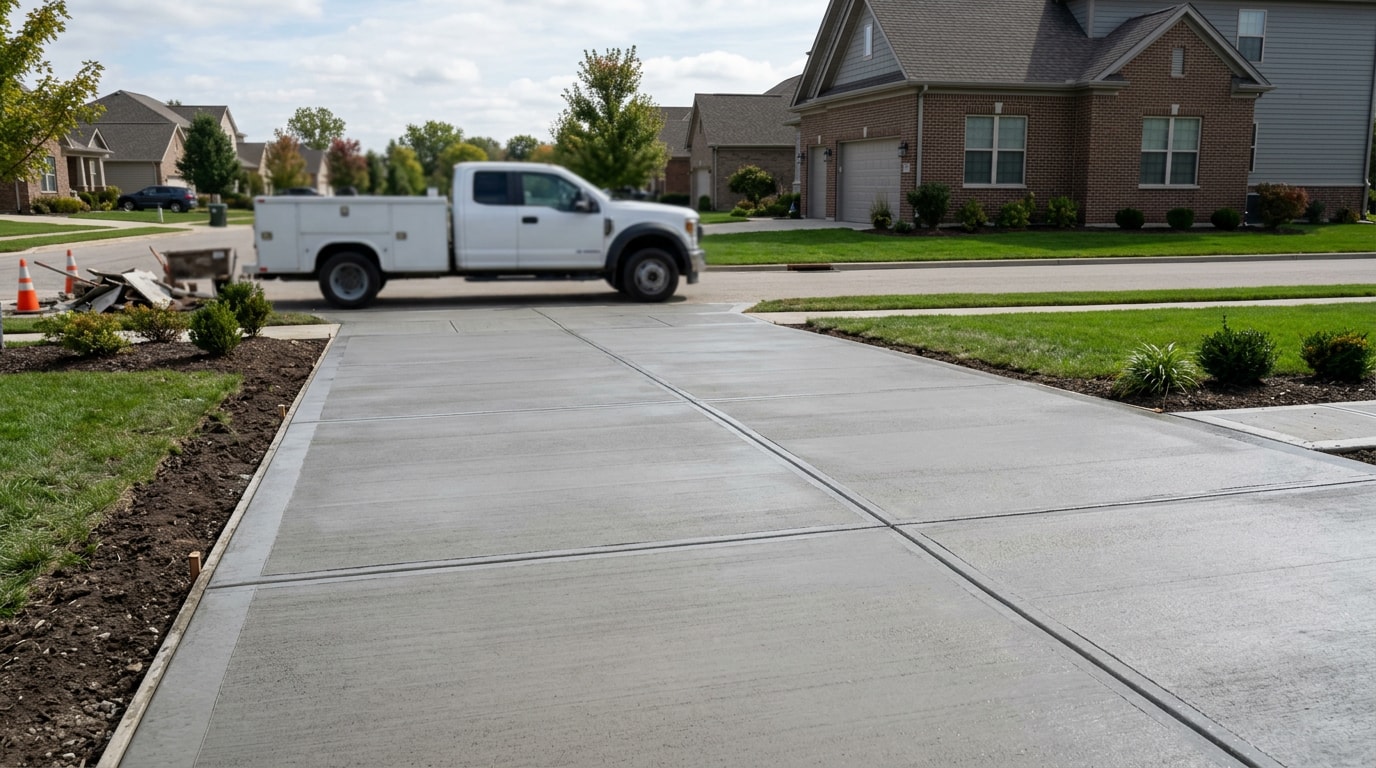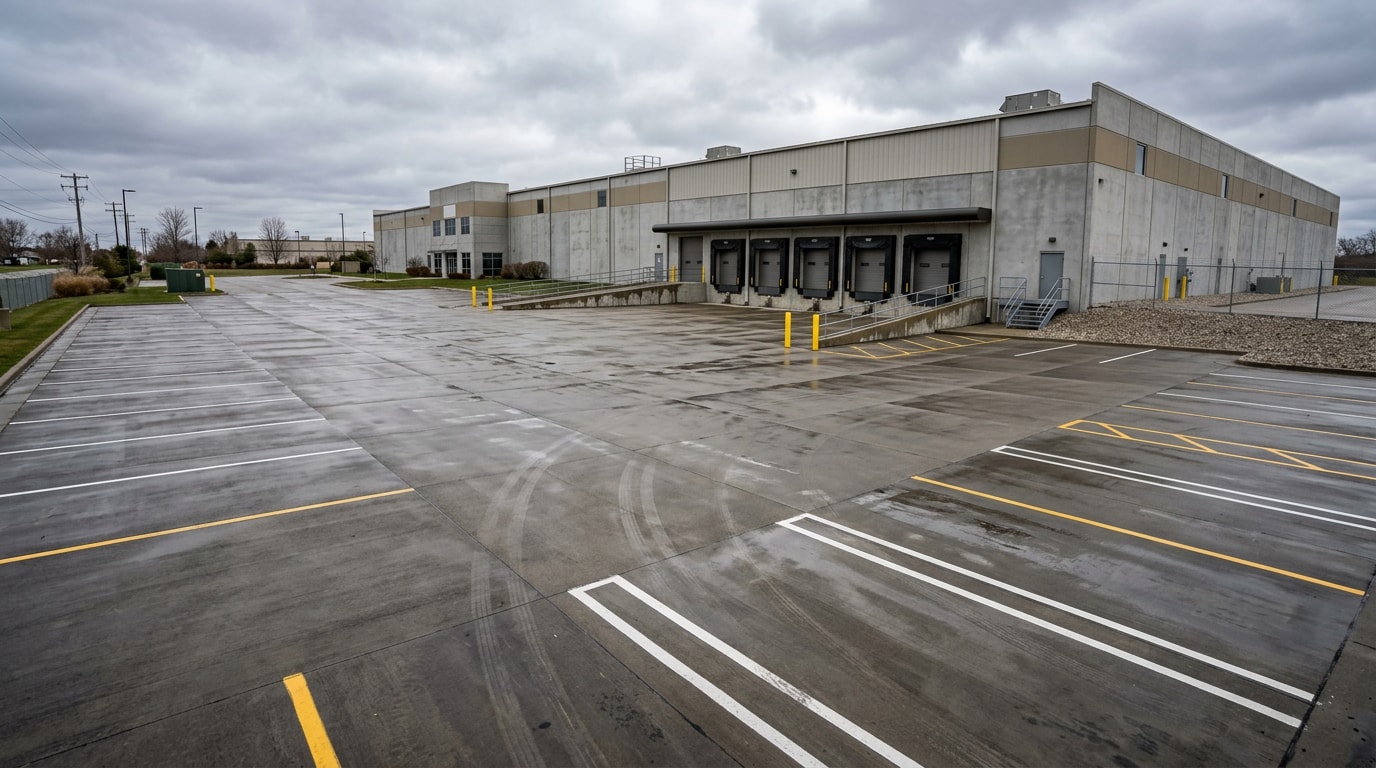
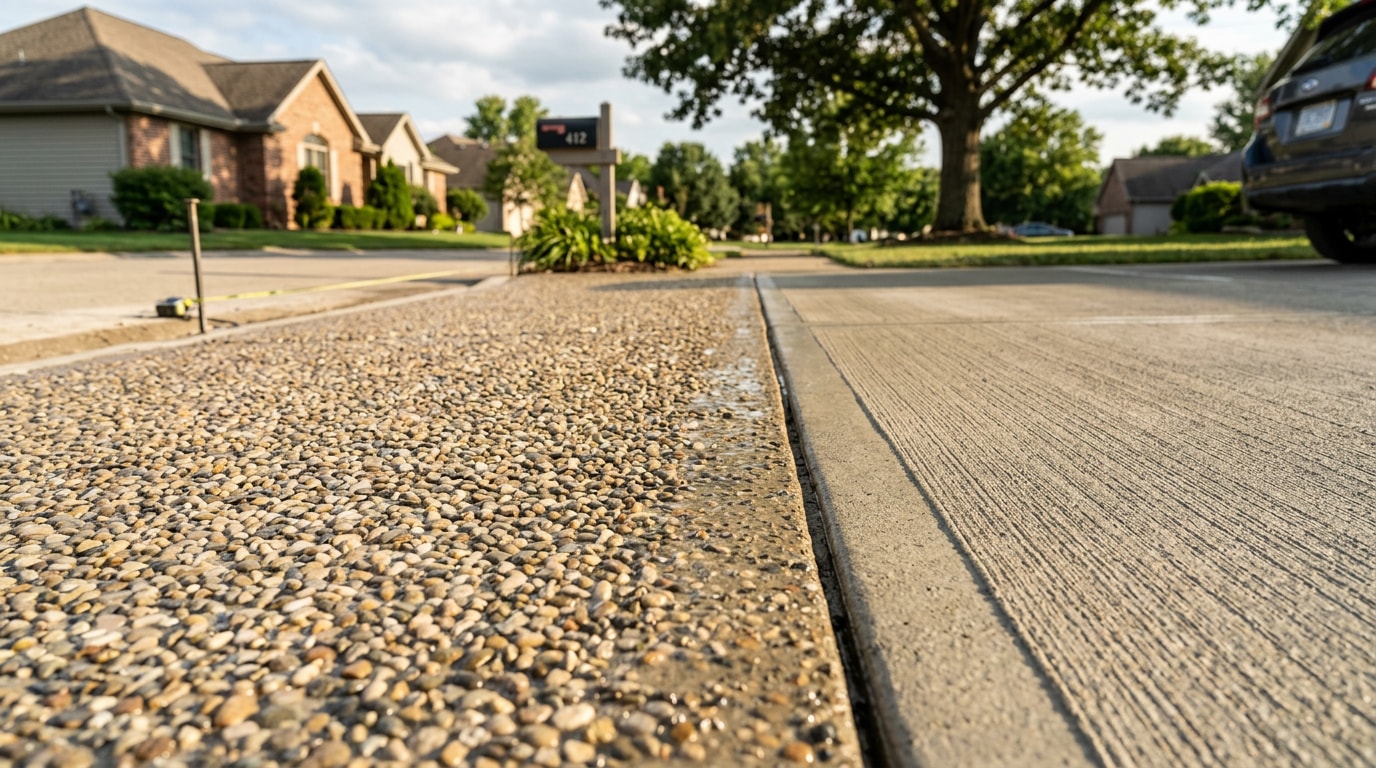
A concrete retarder slows cement hydration, buying a Fishers, IN crew extra working time before a pour stiffens up. Indiana's July afternoons push hydration fast enough to catch a finishing crew off guard, and a mistimed truck can turn a simple driveway into a cold-joint repair job. Here's what a retarder actually does, which type fits a given pour, and when local crews reach for one.
What Is a Concrete Retarder?
A concrete retarder is a chemical product that delays the setting time of concrete or slows hydration at the surface, giving crews more time to place and finish a pour before the material stiffens. It's a standard job-site tool, not a fix for a bad mix design.
The delay is temporary. Once the effect wears off, hydration resumes and the concrete gains strength on its own schedule. Used correctly, a retarder doesn't permanently weaken final strength or durability.
In our crews' experience prepping Fishers driveways and patios through the summer, nearly every afternoon pour scheduled after 1 p.m. in July comes with a retarder request, because the heat moves faster than a two-person finishing crew can keep up with. If you're comparing a local concrete contractor for an upcoming job, knowing how retarders work helps you ask the right questions before the truck shows up.
Surface Retarders vs. Integral Retarders
Most people searching for "concrete retarder" are actually looking for one of two very different products. Mixing them up leads to the wrong purchase.
Integral (admixture) retarders get added to the batch at the plant or on-site. They delay set across the entire pour and are what most ready-mix suppliers mean when they talk about retarder for hot-weather or mass-pour work.
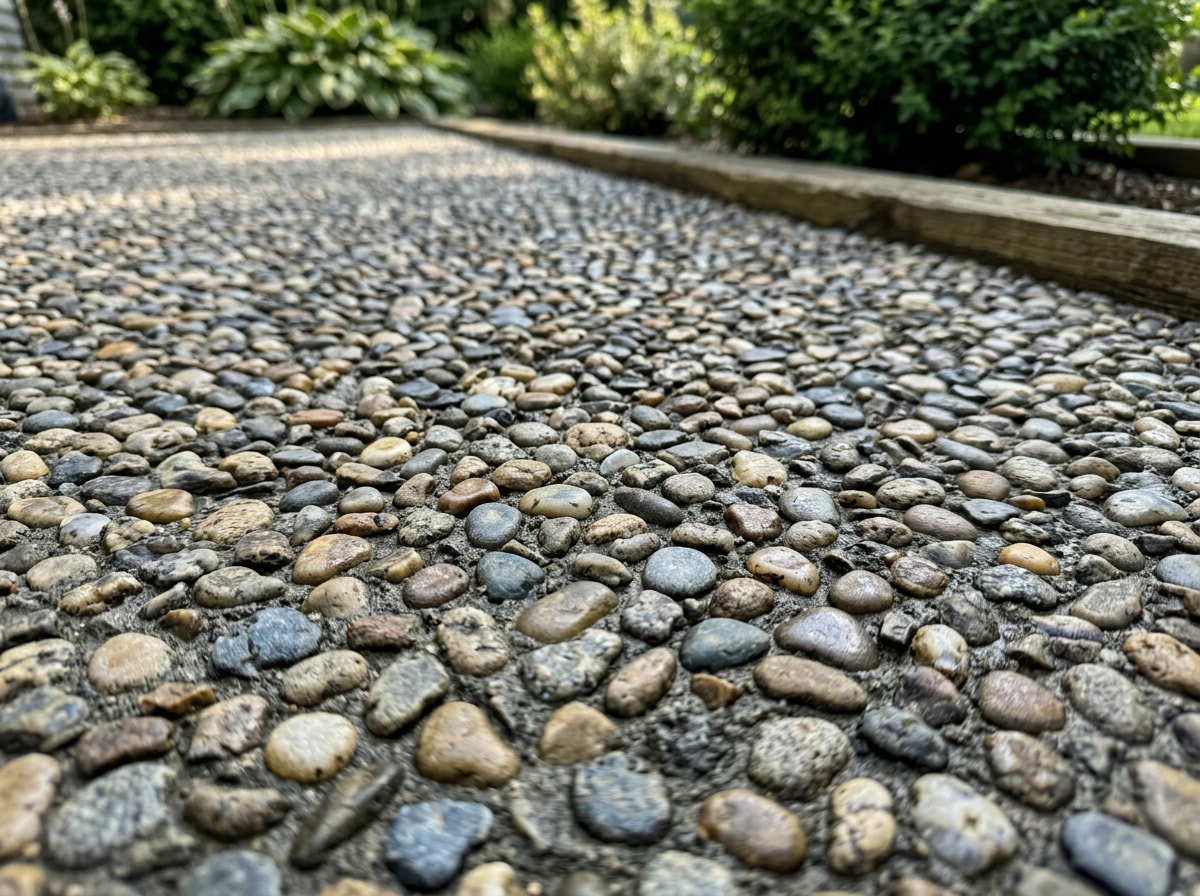
Surface (topical) retarders get sprayed onto the top of freshly placed concrete. A surface retarder is a spray-applied, water-soluble product designed to slow the set of surface mortar so the aggregate can be exposed, temporarily halting the set of Portland cement at the surface while the concrete below cures normally. Crews wash off that soft top layer once the slab firms up, revealing the aggregate underneath for exposed-aggregate driveways, stamped borders, and decorative walkways.
| Feature | Integral (Admixture) Retarder | Surface (Topical) Retarder |
|---|---|---|
| How it's applied | Mixed into the batch before or during delivery | Sprayed or rolled onto the fresh slab surface |
| What it delays | Hydration of the entire pour | Hydration at the top ¼" to ½" only |
| Typical use | Hot weather, long hauls, mass pours | Exposed-aggregate finishes, decorative flatwork |
| How it's "removed" | Not removed; effect fades on its own | Washed or scrubbed off to expose aggregate |
ASTM C494 covers the chemical admixtures added to hydraulic-cement concrete and classifies them into eight types based on function.
Plain retarding admixtures fall under Type B , while combined water-reducing-and-retarding products are classified as Type D . That classification only applies to integral admixtures, not the surface products used for exposed aggregate.
If a job calls for exposed aggregate, decorative crews sometimes pair surface retarder with light abrasive cleaning afterward to get an even reveal. A concrete sandblasting pass can clean up areas where the retarder didn't strip evenly, without damaging the aggregate underneath.
Integral Retarder Chemistries
Integral retarders generally fall into two chemical families.
- Organic retarders — lignosulfonates, hydroxycarboxylic acids and their salts, and similar compounds. These are effective at low dosages and are common in precast, exposed-aggregate, and decorative concrete because they offer predictable delay windows and good workability.
- Inorganic retarders — mineral-based compounds rather than the organic acids used above. They're less common in standard ready-mix work and tend to show up in specialty mixes or extreme job-site conditions, such as mass pours or mixes already loaded with several other admixtures.
How Do Concrete Retarders Work?
A retarder works by interfering with the early hydration reactions of tricalcium silicate (C3S) and tricalcium aluminate (C3A), the two compounds most responsible for how fast cement sets. Retarder molecules adsorb onto these particles and slow the reactions that would normally trigger stiffening.
In practice, the retarder complexes with C3A and comes out of solution, coating the hydrating material and holding back the set. This creates a "dormant period," a window where the mix stays plastic and workable longer than it otherwise would.
That dormant period isn't indefinite. After a predictable stretch, the retarding mechanism fades and hydration resumes, moving the concrete toward its normal final set and strength gain.
For a Fishers crew, this plays out differently depending on the weather:
- Hot-weather pour (85°F+): heat accelerates hydration on its own, so a retarder buys back lost working time and helps avoid a rushed, uneven finish.
- Cool-weather pour (below 60°F): the same dosage can stretch the dormant period too long, delaying finishing work and tying up a crew's schedule.
That's why dosage usually gets adjusted for ambient temperature rather than used at a flat rate year-round. Set-retarders delay hydration, allowing longer workable times in hot weather and mitigating rapid stiffening.
Advantages and Disadvantages
Advantages
- Extends workable time, especially in hot weather where early setting can cause cold joints between layers of a large or stacked pour.
- Spreads out the heat of hydration in mass concrete, reducing the internal temperature spike that can drive cracking.
- Gives finishers a realistic window to place, consolidate, and finish before the surface sets up.
Disadvantages
- Increases bleeding risk in some mix designs.
- Can react unpredictably with air-entraining agents or plasticizers already in the mix.
- Overdosing in cool weather can delay a job far longer than planned, tying up crews and equipment.
A trial batch is worth the time before combining admixtures on a job that can't afford a surprise.
Effects on Concrete Properties
Retarded concrete typically shows lower early compressive strength than an identical mix without a retarder, though that gap closes as curing continues. Workability improves in the short term, and properly cured retarded concrete ends up just as durable as a plain mix of the same design.
Bleeding behavior is less predictable. Some retarders reduce bleeding; others increase it, depending on chemistry and dosage. This is one reason admixture selection usually falls to whoever's managing the mix design rather than a one-size-fits-all rule.
When Fishers Crews Use a Retarder
Retarders show up most often in hot-weather concreting, mass or layered pours, and ready-mix deliveries that travel a long distance before reaching the site. In every case, the goal is the same: stop the mix from setting before it's properly placed and finished.
Indiana's summer pour season is a textbook example. Crews use retarder to prevent flash-setting and shrinkage cracking when temperatures push hydration faster than a crew can physically keep up with.
Locally, Fishers ready-mix and decorative-concrete crews commonly request retarder for summer driveway, patio, and exposed-aggregate pours. If you're scheduling a slab job this summer, our guide to concrete slabs in Fishers, IN covers costs and permit basics worth knowing before the truck arrives. Anyone comparing a surface preparation crew for a warm-weather project should also ask whether retarder is standard in the mix or an add-on cost.
How to Use Concrete Retarder in a Mix
The steps below are general guidance for contractors who already understand what a retarder does and need to apply it correctly. Dosage and timing still depend on the specific product and mix design.
Mixing Procedure
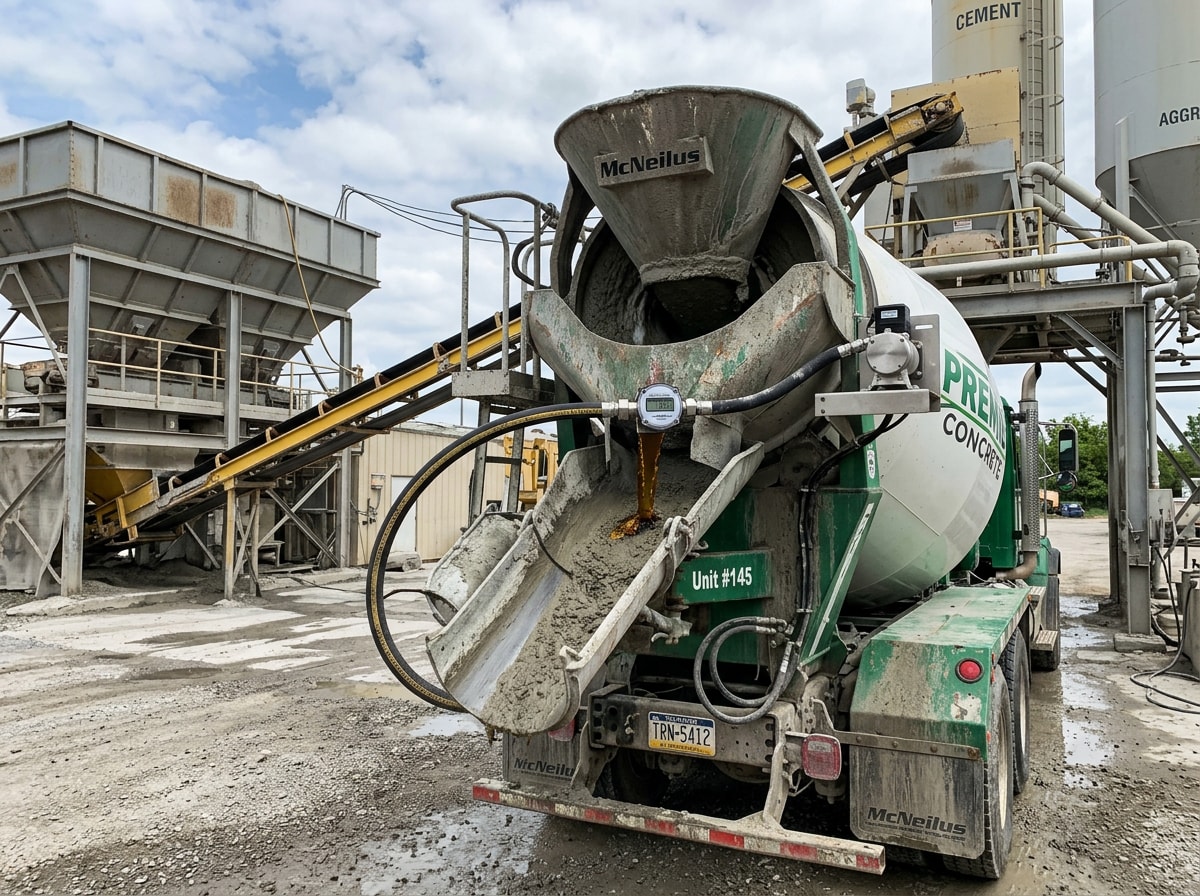
- Liquid retarders can be added directly with the mixing water, which makes dosing straightforward at a batch plant or job site.
- Powdered versions usually need to be pre-dissolved or blended earlier in the batching sequence.
- Adding retarder at the plant versus dosing it at the job site can shift how long the dormant period actually lasts, so consistency in timing matters as much as how much is used.
Compatibility Checks
- Confirm the retarder is compatible with any air-entrainers, plasticizers, or supplementary cementitious materials already in the mix.
- Run a small trial batch before a full pour to catch most compatibility issues early.
- Flag unusual finishing conditions (steep slope, large slab, long pump line) before dosing, since those change how much working time a crew actually needs.
If that sounds like more risk than you want to manage on your own, a concrete surface preparation crew serving Fishers, IN can handle admixture dosing and finishing as part of the job. You can browse past work on our projects page or get a free estimate before you schedule a pour.
FAQ
What additive slows down concrete setting?
A concrete retarder is the additive used to slow concrete setting. Mixed into the batch, it delays setting time and gives crews more working time before the mix stiffens and loses workability.
What's the difference between a surface retarder and an admixture retarder?
An admixture (integral) retarder is mixed into the whole batch and slows hydration throughout the pour. A surface retarder is sprayed onto the top of fresh concrete and only delays the top layer, so it can be washed off later to expose the aggregate underneath.
Does using a retarder weaken the concrete?
Not if it's dosed correctly. Retarded concrete usually shows lower early strength, but that gap closes as curing continues, and a properly cured retarded mix ends up as durable as a plain mix of the same design. Overdosing or mismatched admixtures are the usual cause of problems, not the retarder itself.
Can a retarder be used with concrete stains or sealers?
Yes. Surface retarders are often combined with concrete coloring agents, stains, and sealers to enhance the decorative appearance of exposed-aggregate finishes. Integral retarders don't interact with stains or sealers directly since they're mixed into the batch, not applied topically.
Was there a case of concrete price-fixing in Indiana?
Yes, and it's well documented. A central Indiana concrete company agreed to pay $29 million to settle a class-action antitrust lawsuit alleging it and six other companies conspired to fix the price of ready-mixed concrete.
The Department of Justice also fined several other concrete companies in the scheme, including Fishers-based Builder's Concrete & Supply Co. Inc., with total fines for Indianapolis-area companies reaching $35.2 million and nine executives receiving prison sentences. It's a reminder that ready-mix pricing in the Indianapolis metro, including Fishers, has a documented history worth knowing if you're ever comparing quotes that seem suspiciously uniform.
How much does ready-mix concrete cost per yard in Indiana right now?
There's no official Fishers-specific number published, but NRMCA's benchmarking survey put the average 2023 selling price at $160 per cubic yard nationally. Mix design, admixtures like retarder, and delivery distance within the Fishers/Indianapolis metro all move that number up or down. For a project-specific quote, contact us directly.
Questions about dosing, timing, or whether your project needs a surface or integral retarder? Get a free estimate and we'll walk through what your mix design actually needs before the truck rolls.