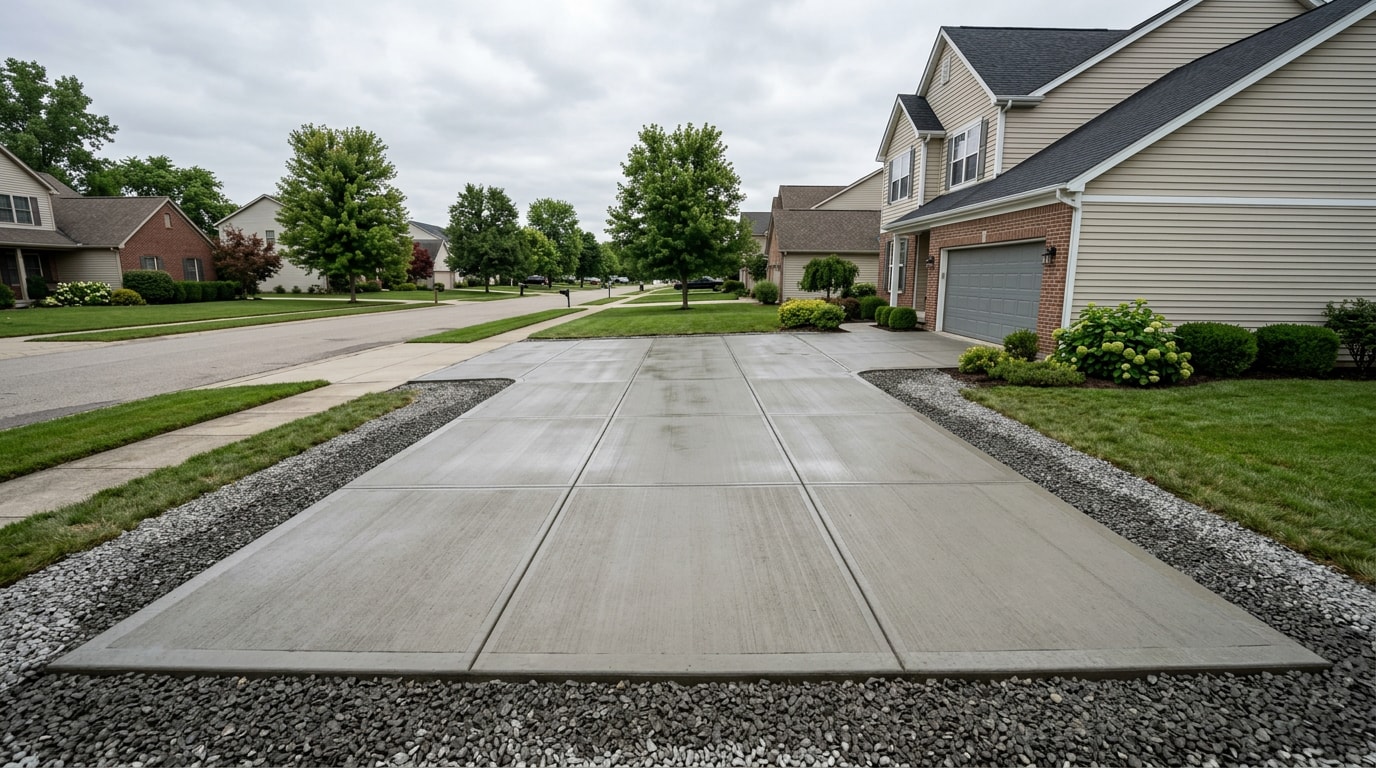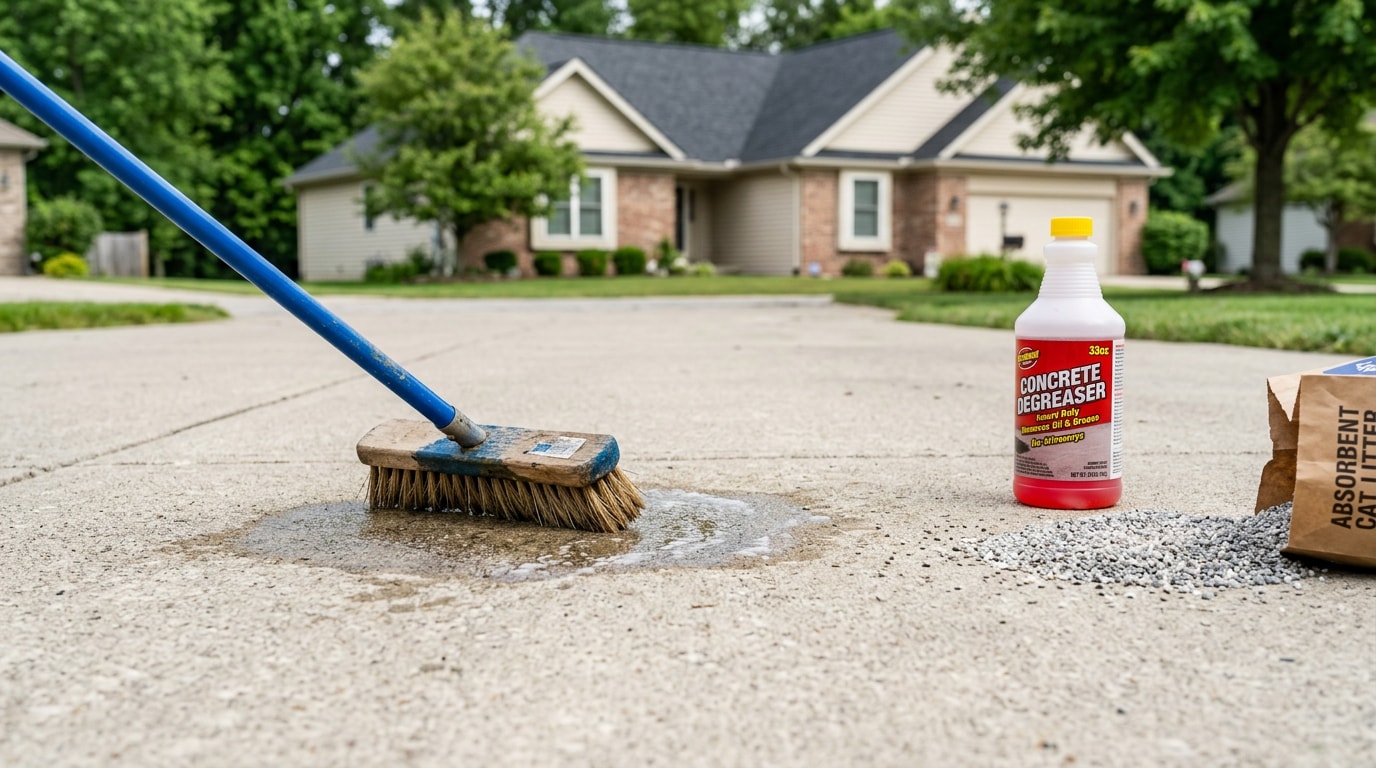
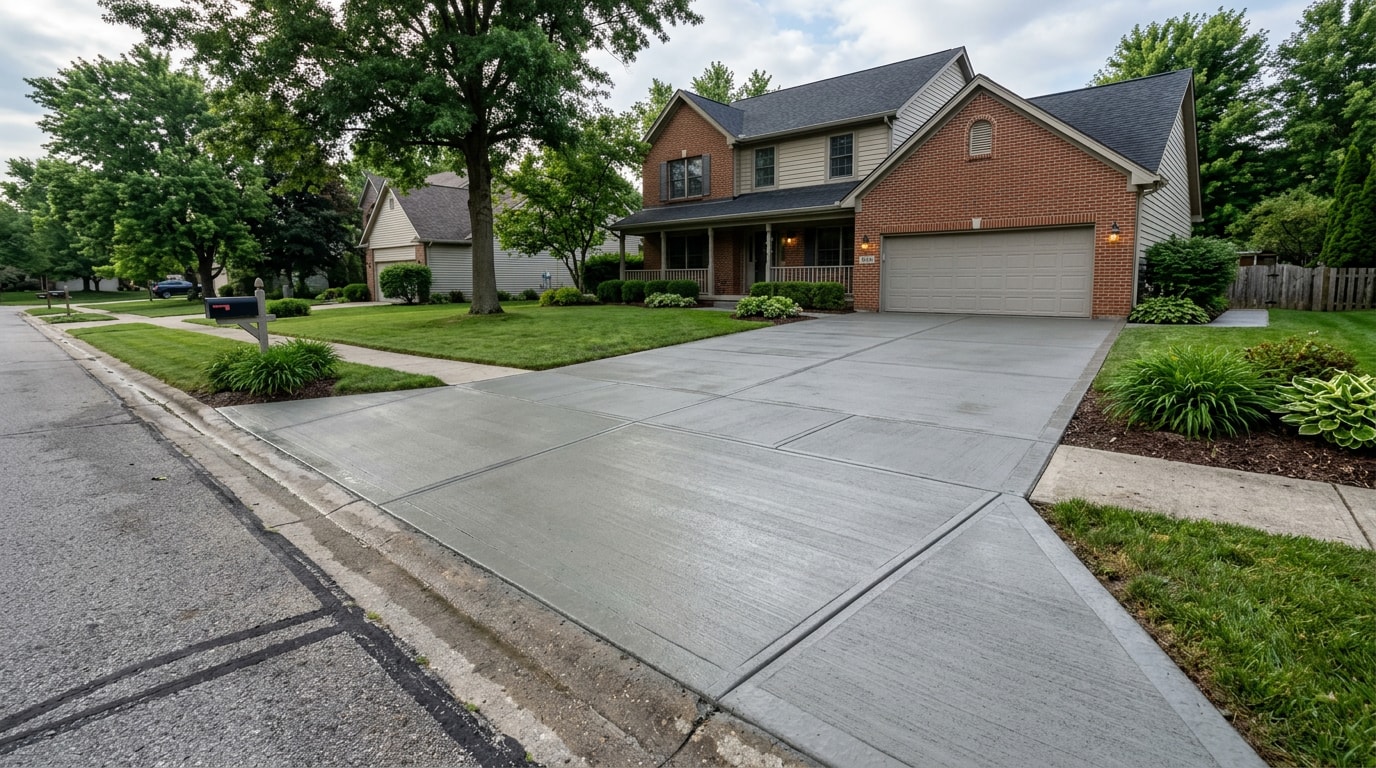
Concrete curing in Carmel, IN decides whether a new driveway handles twenty Indiana winters or starts flaking apart in three. Curing is a chemical reaction, not a waiting game, and Hamilton County's freeze-thaw swings change how long that reaction needs to run before the surface is ready for real use. Here's the actual timeline, the seasonal adjustments, and the permit rules that change your project schedule.
How Concrete Curing Actually Works
Concrete is cement, water, and aggregate (sand and crushed stone) mixed into a paste that hardens as it cures. Cement is just one ingredient in that mix — a fine powder, almost always Portland cement, that reacts with water in a process called hydration.
Hydration is the reaction that actually cures concrete. Water and cement form interlocking crystals that lock the aggregate into a solid mass, and that reaction keeps running for weeks, not hours.
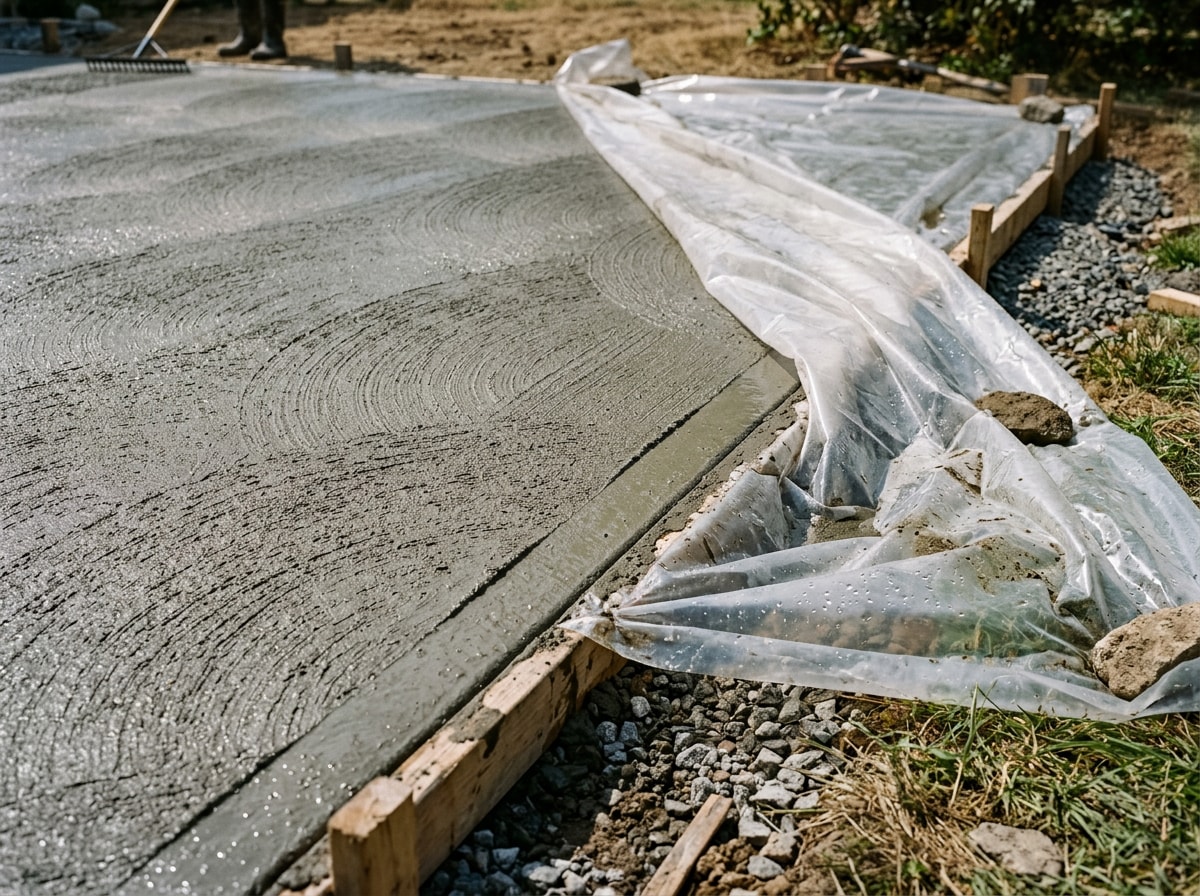
If the surface dries out too fast, hydration stops early and the slab never reaches its design strength. The American Concrete Institute defines curing as maintaining sufficient moisture and temperature so hydration can continue after placement, which is why covering and watering fresh concrete matters more than simply letting it sit in the sun.
How Long Before You Can Use New Concrete in Carmel
Strength gain follows a predictable curve, even though a slab looks "done" within a day of the pour.
| Stage | Typical Timeframe | Approx. Strength | What's Safe |
|---|---|---|---|
| Initial set | 2–6 hours | Not load-bearing | Do not disturb the surface |
| Light foot traffic | 24–48 hours | Roughly 10–15% | Walking only |
| Vehicle traffic (light) | 7 days | Roughly 60–70% | Passenger cars on a driveway |
| Full design strength | 28 days | Close to 100% | Engineering benchmark |
| Ongoing gain | Months after | Slowly climbing | No special precautions needed |
These numbers shift with mix design, temperature, and humidity, so treat them as a planning guide rather than a guarantee for every pour. Repair methods are a different clock entirely — slabjacking and polyurethane foam injection, often used to lift a settled slab instead of replacing it, can cure in hours because the material isn't behaving like a traditional concrete mix.
Curing Concrete Through Carmel's Freeze-Thaw and Humid Seasons
Pouring concrete in Carmel, IN means planning around two extremes: humid summers and freezing winters, both of which interfere with hydration in opposite ways. Late spring and early fall, when daytime temperatures stay moderate and overnight freezes aren't a risk, tend to give concrete the easiest path to full strength.
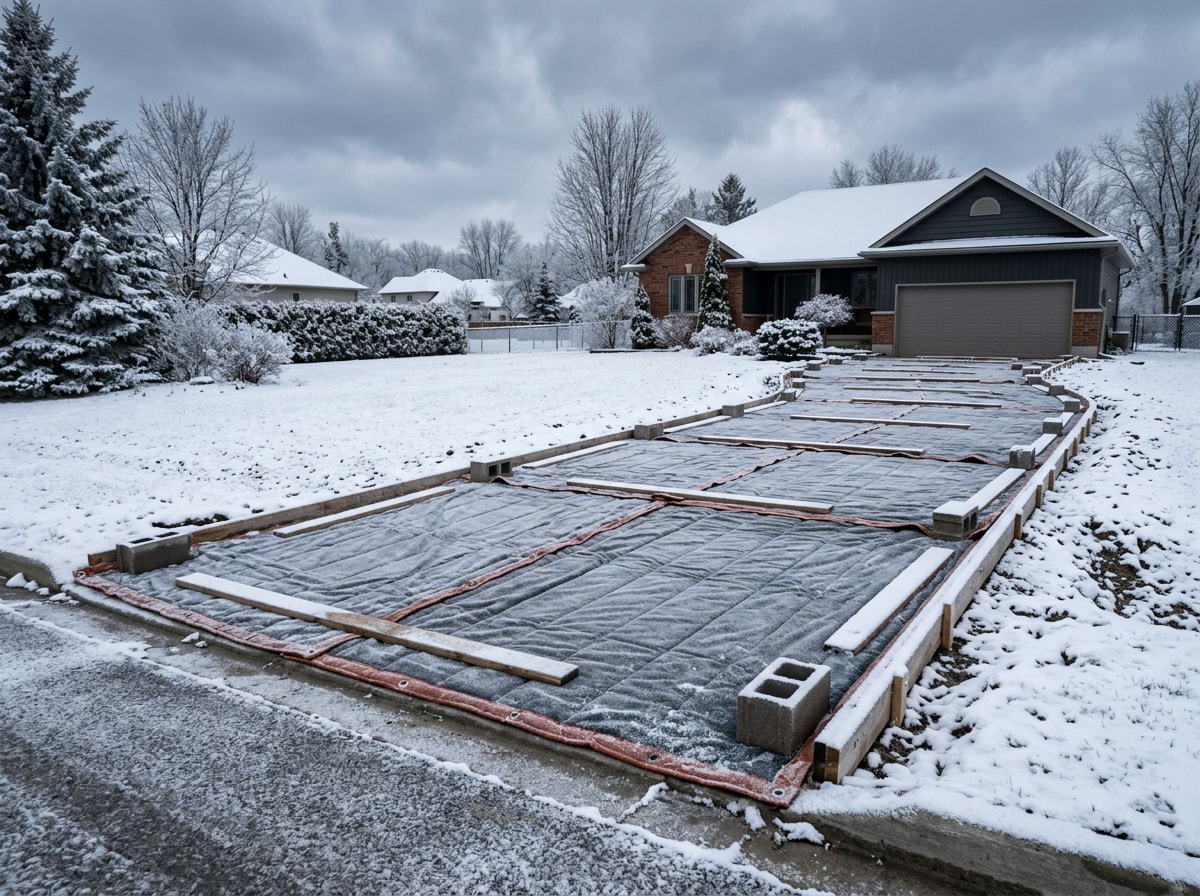
Winter curing is the harder of the two. Hydration slows sharply in cold temperatures and stalls almost completely once water in the mix freezes, so contractors pouring in colder months lean on heated mix water, accelerators, and insulated curing blankets to trap the concrete's own hydration heat. The National Ready Mixed Concrete Association notes that curing should continue for a minimum of three to seven days and that cover materials need to come off gradually to avoid shocking the slab with a sudden temperature swing.
Summer brings the opposite problem. Heat and direct sun pull moisture out of fresh concrete faster than hydration can use it, which leads to surface cracking and weaker-than-expected strength. Fogging the surface, watering during the first 24 hours, or covering the slab with plastic sheeting all slow that evaporation down.
What Causes Concrete Cracks, and Can They Be Prevented?
Most cracking traces back to one of two very different causes, and mixing them up leads to the wrong fix.
- Shrinkage cracks happen during curing, when moisture leaves the slab faster than hydration can keep pace.
- Settlement cracks show up long after curing is finished, caused by soil movement underneath rather than anything related to the pour.
Curing-related cracks are largely preventable. Properly placed control joints give concrete planned weak points to crack along, keeping shrinkage invisible instead of random, and covering or watering fresh concrete during extreme temperatures cuts the odds of shrinkage cracking significantly. If you're troubleshooting an existing driveway, our guide to concrete driveway repair in Carmel breaks down fixes by crack type and cost.
Before You Seal or Coat: Why Curing and Drying Aren't the Same
This is the step most curing guides skip, and it's the one that actually determines whether a sealer or coating holds up. Concrete can hit its 28-day cure and still be too wet underneath for a coating to bond — curing measures strength, drying measures moisture leaving the slab, and they finish on different schedules.
ASTM F710, the industry standard for preparing concrete floors before resilient flooring or coatings, calls for moisture and pH testing regardless of the slab's age. At Scott's Mobile Blasting, we test slab moisture before starting coating preparation work in Carmel, because a slab that looks dry on the surface can still trap enough moisture to blister a sealer or epoxy within months.
That's also why failed coatings on older driveways usually need more than a quick recoat. Removing the old material first, through concrete surface preparation or concrete sandblasting, gives the new coating a clean, properly tested surface instead of bonding over whatever trapped moisture caused the first failure.
Do You Need a Permit for Concrete Work in Carmel?
Carmel generally requires a permit for new driveway or patio work, particularly where it touches the public right-of-way or changes drainage. Smaller replacement jobs that match the existing footprint sometimes qualify for a lighter approval process, but it's worth confirming before the pour, not after.
Carmel's Driveway Width Rule
The City of Carmel's standard residential driveway width is a minimum of 12 feet and a maximum of 20 feet at the limit of the right-of-way, measured at the street, and the Engineering Department won't support configurations outside that range. Wider or non-standard driveways typically need additional review, which can shift when the curing clock actually starts if inspections get delayed.
Consent to Encroach
Carmel can require an executed consent-to-encroach agreement, approved by the city and recorded with Hamilton County, when a driveway, wall, or similar improvement sits inside a platted easement or the public right-of-way. Skipping this step when it applies can delay inspections and push back your pour date. A local contractor should flag this during initial planning, and you can always get a free estimate before locking in a schedule.
How Long Does Cured Concrete Actually Last in Carmel?
Properly cured concrete is built to last decades. A driveway or patio cured with adequate moisture retention and seasonally appropriate techniques can reasonably be expected to hold up for 25 to 30 years or more in a climate like Carmel's.
Concrete that cures too fast, dries out early, or gets pushed into heavy use before it's ready tends to develop scaling, cracking, or weakened load capacity years ahead of schedule. The days spent curing correctly are the real determining factor, more than almost anything else in the build.
Why a Fully Cured Slab Can Still Move Later
A slab can be perfectly cured and still shift years down the road, and that's not a curing defect — it's changing ground conditions underneath it.
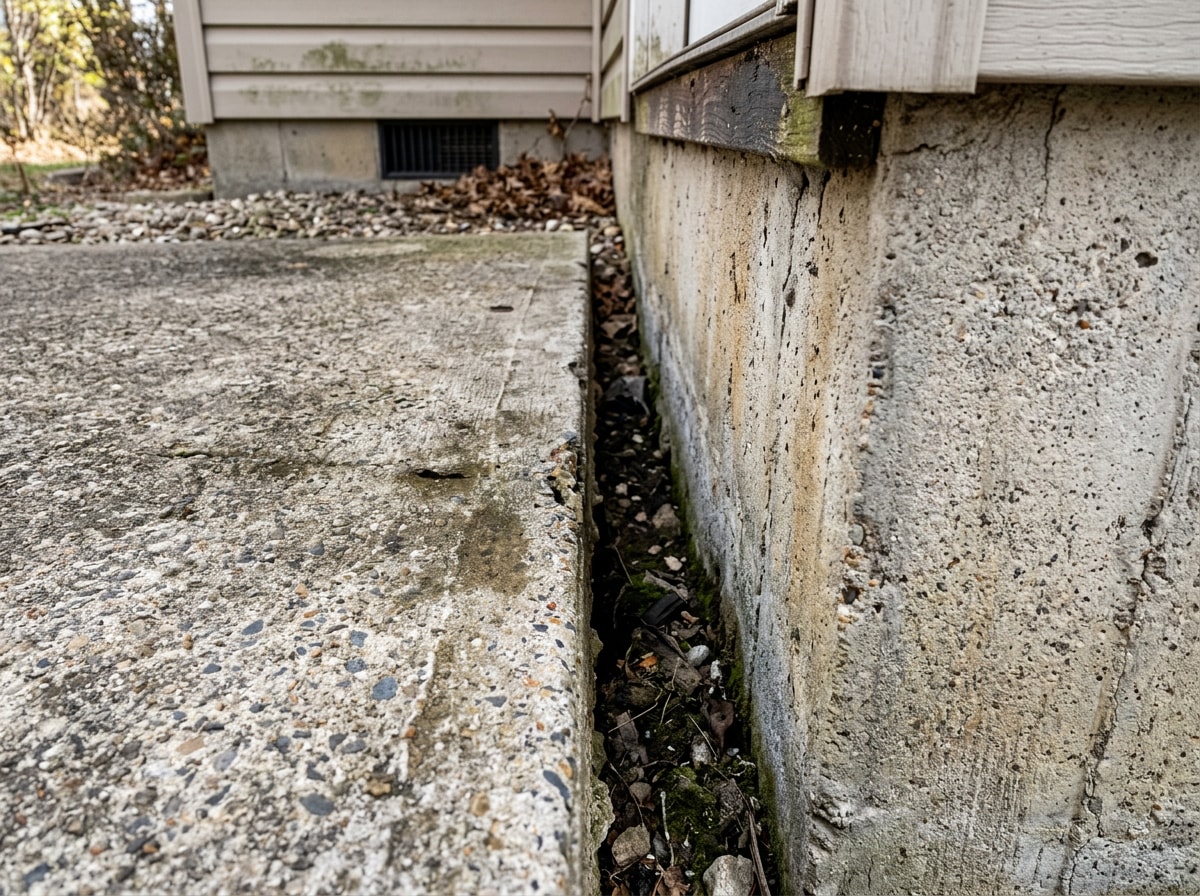
Erosion. Rain and runoff gradually wash fine soil particles out from under a slab, especially near downspouts or low-lying areas, leaving voids where support used to be. Sections of a sidewalk or patio can tilt, sink, or separate at the joints even though the original pour cured perfectly.
Clay soil and freeze-thaw cycles. Central Indiana's clay soil expands and contracts with moisture changes, and winter freeze-thaw cycles make that movement worse each year. A slab that was level for a decade can gradually shift as the soil underneath swells and shrinks around it.
FAQ
How long does concrete need to cure before it's ready to use?
Light foot traffic is generally safe after 24–48 hours. Plan on 7 full days before driving on it, and treat 28 days as the benchmark for full design strength.
What's the difference between curing and drying concrete?
Curing is the hydration reaction that builds strength; drying is moisture leaving the slab. A slab can be fully cured at 28 days and still be too wet for a coating, which is why ASTM F710 calls for moisture testing regardless of age.
Will a repaired or newly cured slab settle again?
A properly cured or repaired slab shouldn't settle on its own, but the same soil conditions that caused the original movement can resurface over time. Fixing drainage and erosion around the slab significantly reduces the odds of a repeat.
How much does concrete cost per yard in Carmel/Indiana?
Standard 3,000–4,000 PSI ready-mix concrete in Indiana typically runs in the range of $115 to $175 per cubic yard, with price shifting based on PSI strength, additives, and delivery distance. Getting a quote from a local supplier is the most reliable way to budget, since material costs move often.
What are the advantages of hiring a concrete contractor?
A professional manages the variables that determine whether curing succeeds: moisture retention, temperature control, and timing around weather. DIY pours often skip covering, watering, or cold-weather adjustments, which are exactly the details separating a driveway that lasts decades from one that cracks within a year. If you're prepping an older slab for paint or sealer, pre-painting surface prep is worth asking about before a recoat.
How much does concrete lifting cost?
Slabjacking typically costs less than full replacement, often running from a few hundred dollars to around a thousand per slab section depending on how much settling needs correcting. It's a faster, lower-cost option when the concrete itself is sound but the ground underneath has shifted.
Are contractors licensed and insured for concrete work in Carmel?
Reputable concrete and surface prep contractors working in Carmel carry licensing and insurance appropriate to local requirements and should share proof on request. A contractor who follows proper protocol on paperwork is also more likely to manage curing and prep correctly on the job itself. You can see examples of completed work on our projects page or reach out through contact us for a free estimate.