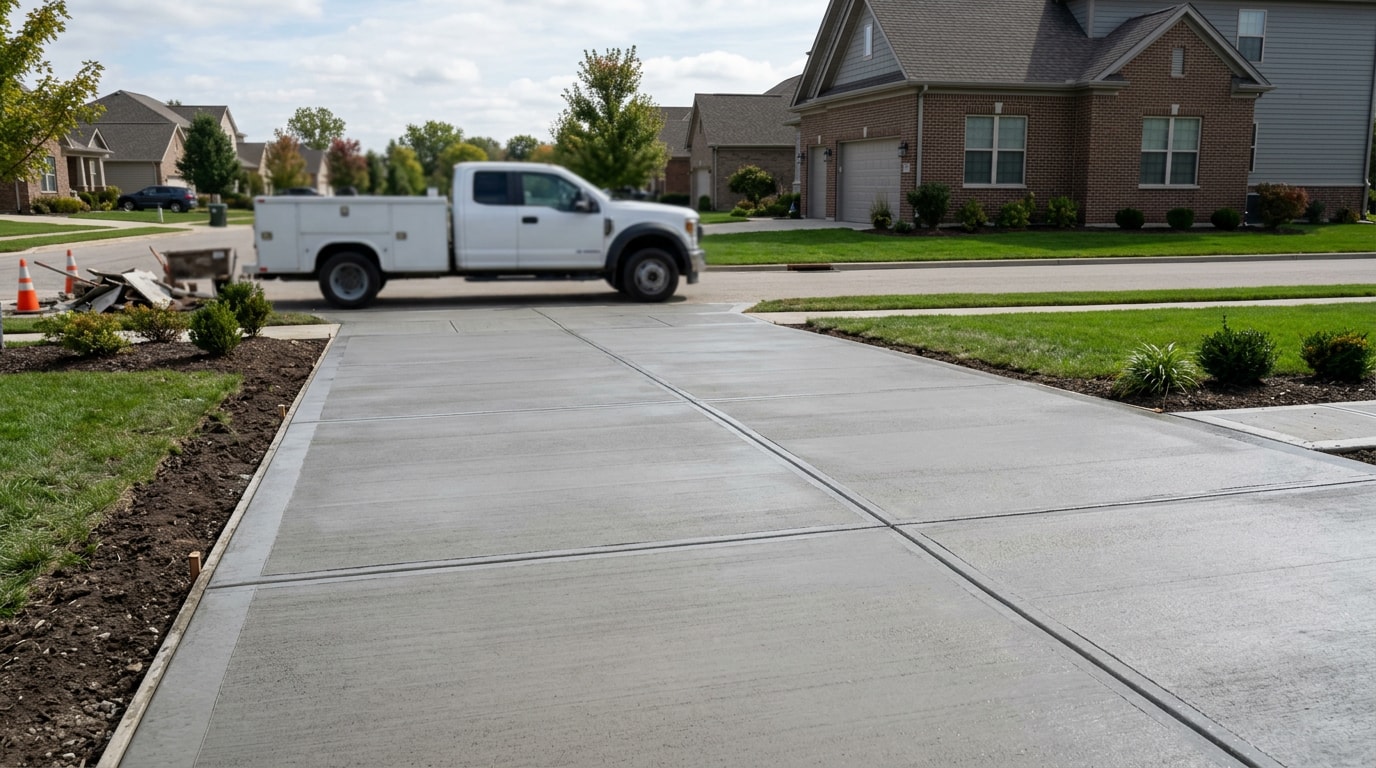
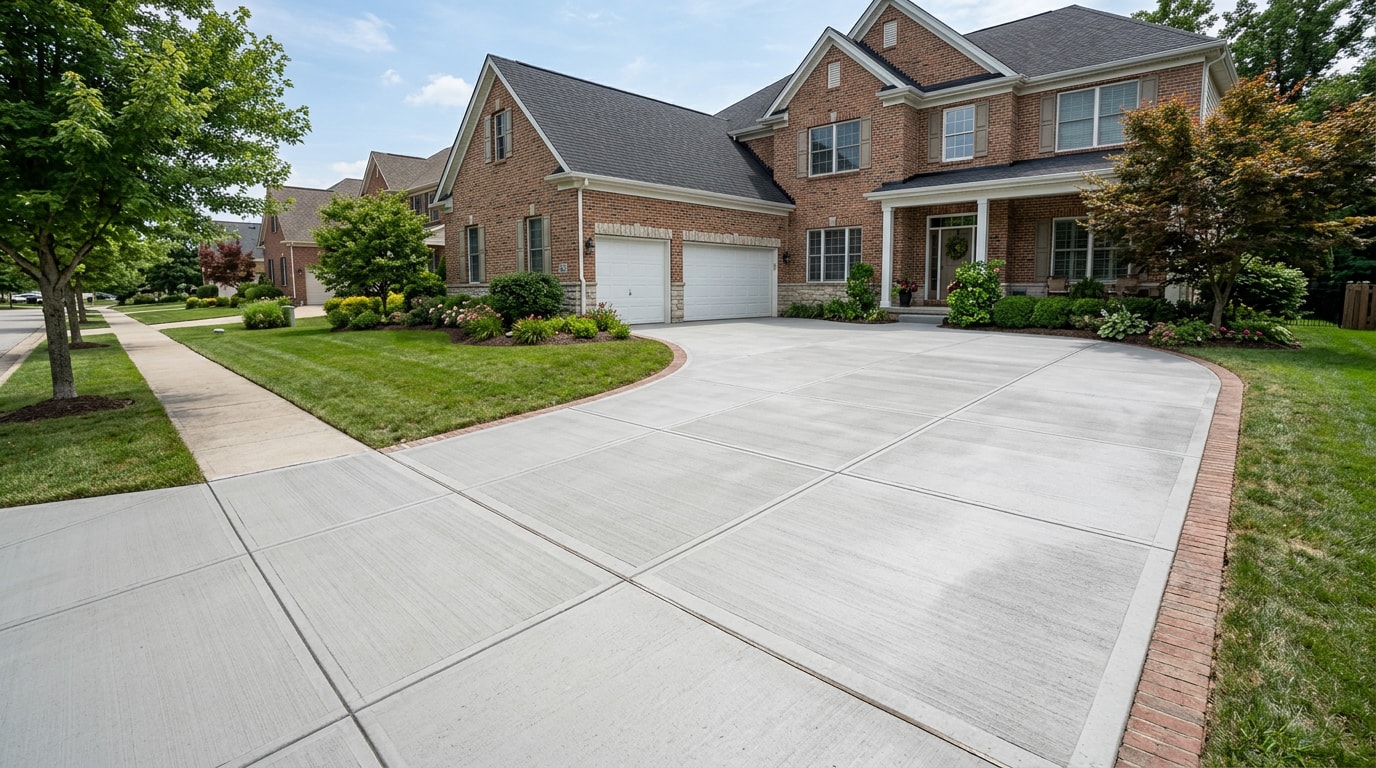
A concrete calc for Carmel, IN projects comes down to three numbers: length, width, and depth. Get those right and you order the correct amount the first time. Get them wrong and you're either paying for a second short-load delivery or hauling away leftover concrete that hardened in the truck.
This guide gives you the exact formulas ready-mix dispatchers and masonry crews use, a quick-reference yardage table for common Carmel project sizes, and straight answers to the cost questions homeowners ask before they order.
Quick Concrete Yardage Reference for Carmel Projects
Before running your own math, check whether your project matches one of these common sizes. All figures assume a standard 4-inch slab and already include a 10% waste buffer.
| Project Size | Square Footage | Cubic Yards Needed (4") | 80-lb Bags (if hand-mixing) |
|---|---|---|---|
| 10×10 ft (shed pad) | 100 sq ft | 1.4 yd³ | 63 bags |
| 12×12 ft (patio) | 144 sq ft | 2.0 yd³ | 90 bags |
| 16×16 ft (patio/pad) | 256 sq ft | 3.5 yd³ | 158 bags |
| 20×20 ft (garage slab) | 400 sq ft | 5.4 yd³ | 244 bags |
| 20×24 ft (two-car driveway) | 480 sq ft | 6.6 yd³ | 297 bags |
| 24×24 ft (detached garage) | 576 sq ft | 7.8 yd³ | 353 bags |
For anything larger, or a project with a slope, drain, or thickened edge, it's worth running site-specific numbers with a free estimate rather than trusting a flat table.
How to Calculate Concrete by Hand
Flatwork, slabs, patios, and sidewalks all use the same volume formula. Here's the process:
- Measure length and width in feet, then multiply to get square footage.
- Convert your depth to feet (4 inches = 0.33 ft, 6 inches = 0.5 ft).
- Multiply square footage by depth to get cubic feet.
- Divide cubic feet by 27 to get cubic yards.
- Add 5-10% for waste, spillage, and subgrade irregularities.
Worked example: A 20×20 slab is 400 square feet. At 4 inches thick, that's 400 × 0.33 = 132 cubic feet, or 4.9 cubic yards once divided by 27. Add a 10% buffer and you're ordering roughly 5.4 cubic yards.
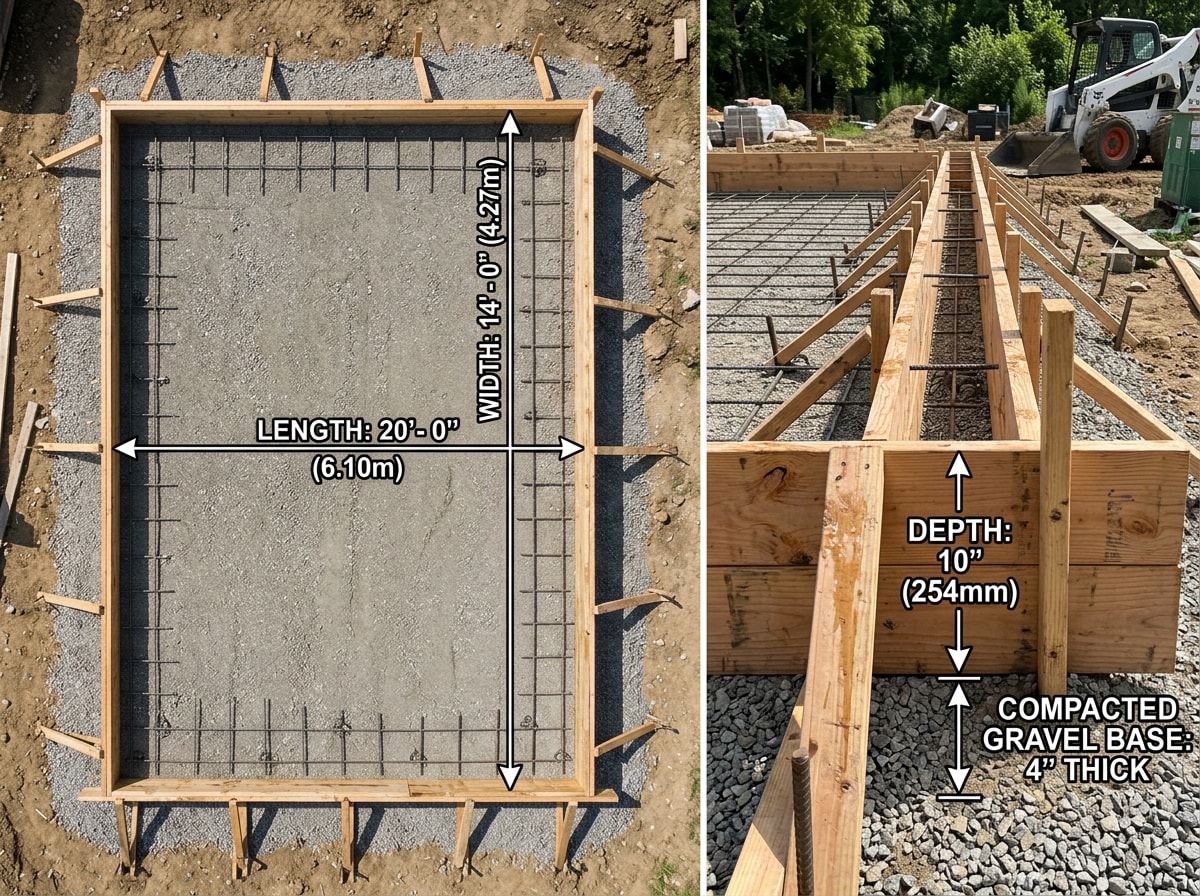
Ready-mix suppliers in the Indianapolis-Carmel market generally price standard 3,000-4,000 PSI concrete somewhere in the $150-$195 per cubic yard range going into 2026, though mix strength, additives, and short-load fees all shift that number. Always call two or three local plants before finalizing a budget, since prices move with fuel and cement costs. The National Ready Mixed Concrete Association's consumer overview explains how concrete is proportioned from cement, water, and aggregate, which is worth a skim if you want to understand why PSI and mix design affect price.
Rounding up matters more than people expect. Slabs rarely pour perfectly flat, subgrade dips eat extra material fast, and running short mid-pour can leave a visible cold joint that never finishes the same as the rest of the slab. If you're sizing a driveway, patio, or garage floor, our team can walk through site-specific numbers before you commit to a delivery.
Post Holes, Footings & Fence Posts: The Cylinder Formula
Cylindrical pours don't use the length × width × depth formula at all. Fence posts, deck footings, and round columns need:
π × radius² × height ÷ 27 = cubic yards
Diameter divided by two gives you the radius. A 12-inch-diameter hole has a 6-inch, or 0.5-foot, radius. A 10-inch-diameter hole 3 feet deep works out to about 0.09 cubic yards, or roughly 4 bags of 80-lb fast-setting mix.
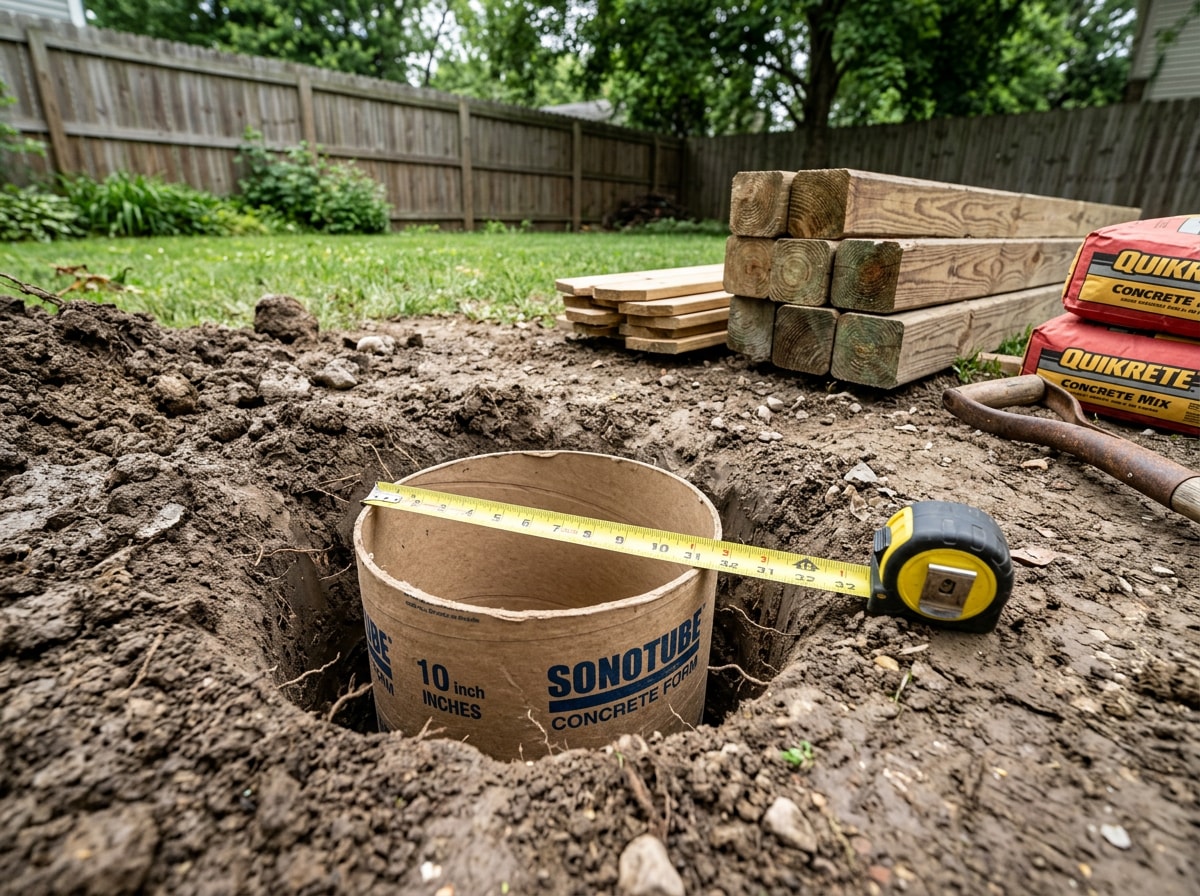
Depth matters more here than the formula does. Indiana's freeze-thaw cycles heave shallow footings right out of the ground over a few winters, which is why the Indiana Residential Code sets county-by-county minimum footing depths rather than one statewide number. The International Residential Code requires every exterior footing to sit at least 12 inches below undisturbed grade and below whatever frost line depth the local jurisdiction adopts, and that frost-protection rule is spelled out in IRC Chapter 4. Most Hamilton County jurisdictions land in the 30 to 36-inch range, but confirm the exact figure with Carmel's building department before you dig, since amendments change between code cycles.
Fast-setting mixes are popular for posts because they cure in place without mixing in a wheelbarrow. In our own surface-prep work around Carmel, the posts that fail early are almost always the ones poured a few inches above frost depth to save one bag of concrete, not the ones that got the mix ratio slightly wrong.
Mortar Mix: Bags Needed for Brick & Block Projects
Mortar solves a different problem than poured concrete. It bonds individual units together instead of forming a structural slab or footing, so the math is based on unit count rather than volume alone.
- Standard 8"×2"×4" bricks: roughly 6-7 bricks per 80-lb bag of mortar mix.
- 8"×8"×16" concrete blocks: roughly 3 blocks per 80-lb bag.
- Joint thickness shifts both numbers. A thicker joint uses more mortar per unit.
If your project is block-based, our 8x8x16 concrete block price guide for Indianapolis breaks down current per-block costs alongside the mortar math above.
Mortar also comes in different ASTM C270 types, each rated for a different structural load:
| Type | Typical Use | Minimum Compressive Strength |
|---|---|---|
| Type M | Below-grade, retaining walls, heavy loads | 2,500 psi |
| Type S | At-grade exterior, load-bearing walls | 1,800 psi |
| Type N | Above-grade, general purpose, veneer | 750 psi |
The Brick Industry Association's technical note on mortar types and ASTM C270 classifications is a solid reference if you're unsure which type your project calls for before you order.
Ready-Mix vs. Bagged Concrete: Which Makes Sense in Carmel?
Bagged concrete makes sense for small pours. Ready-mix wins on anything larger. Here's the quick breakdown:
- Under 1 cubic yard: Bagged mix is usually cheaper once you factor in short-load delivery fees, which many plants charge below a 2-3 yard minimum.
- 1-2 cubic yards: This is the gray zone. Compare your local plant's short-load fee against the cost of 45-90 bags plus mixing time.
- Over 2 cubic yards: Ready-mix almost always wins. One 80-lb bag yields about 0.6 cubic feet of finished concrete, so it takes roughly 45 bags to equal a single cubic yard. Mixing that many bags by hand on a driveway-sized pour is a full-day job before you've even started finishing.
FAQ
How much should a 20x20 concrete slab cost?
A 20×20 slab at standard 4-inch depth needs about 5.4 cubic yards including waste buffer. Material alone typically runs in the $800-$1,050 range at current 2026 ready-mix pricing, while a fully installed slab, including labor, forming, and finishing, often lands between $3,500 and $6,000 depending on site prep and finish. Request a free quote for numbers specific to your lot.
How much is 1 yard of concrete in Indiana?
Most Indianapolis-area ready-mix plants price standard concrete somewhere between $150 and $195 per cubic yard delivered, though PSI, additives, and distance from the plant all move that number. Call two local suppliers directly before budgeting, since pricing shifts throughout the year.
How many 80-lb bags of concrete equal one cubic yard?
About 45 bags. One 80-lb bag yields roughly 0.6 cubic feet of finished concrete, and a cubic yard holds 27 cubic feet, so 27 ÷ 0.6 = 45 bags.
How deep should a fence post footing be in Carmel?
Deep enough to clear the local frost line, which most Hamilton County jurisdictions set at 30 to 36 inches below grade. Confirm the exact depth with Carmel's building department, since the Indiana Residential Code sets this county by county rather than statewide.
How do I calculate how much concrete I need to order?
Multiply length × width × depth, all in feet, then divide by 27. That's the standard cubic-yards formula ready-mix suppliers use. Round the result up and add a 5-10% buffer before you order to cover spillage and uneven subgrade.
Is it cheaper to use bagged concrete or order ready-mix for a driveway?
For anything over roughly 2 cubic yards, ready-mix almost always costs less per yard and saves a full day of hand-mixing. Bagged concrete only makes sense for small pours like post holes or patch repairs.
Getting the yardage right is only half the job. If your new slab, patio, or driveway in Carmel, IN needs cleaning, coating, or surface prep before or after the pour, our concrete surface preparation team handles that end of the project. Browse recent work on our projects page, check out {{SITE_URL}} for our full service lineup, or get a free estimate before you place your concrete order.